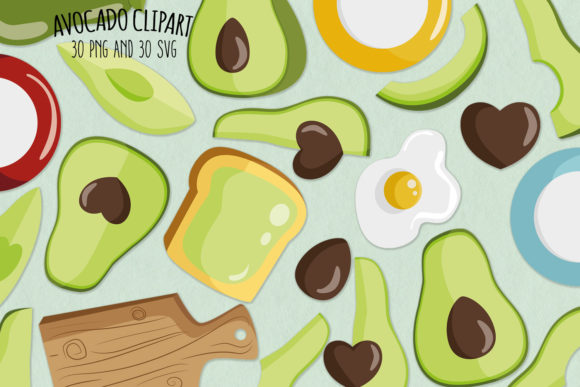
Avocado SVG Clipart Set of 30
A Designer’s First Look: Friendly, Fresh—but Not Automatically Embroider-Ready
As someone who’s stitched avocados onto baby onesies, tote bags for farmers’ markets, and aprons for café owners, I opened the Avocado SVG Clipart Set of 30 expecting playful charm—and got it. The illustrations lean into rounded, approachable shapes with gentle curves, soft outlines, and a consistent hand-drawn warmth. There are whole avocados, halved ones with pits, leaves, stems, and even smiling fruit variations. It’s clearly built for versatility across print-based crafts—card making, scrapbooking, postcards—but as an embroidery designer, my first question wasn’t “Is it cute?” It was “How will this translate in thread?”
Where This Set Shines in Real Embroidery Projects
I tested three motifs from the Avocado SVG Clipart Set of 30 on a linen tea towel, a cotton sweatshirt, and a twill baby cap—each representing common small-business use cases. On the towel, the larger avocado silhouettes held up beautifully with satin-stitch borders and light fill-stitch interiors. Customers love that clean, botanical feel—it reads as thoughtful, not kitschy. On the sweatshirt, the medium-sized halved avocado worked well as a chest emblem: bold enough to read at arm’s length, simple enough to avoid puckering. And on the baby cap? The smallest leaf-and-stem combo (scaled down carefully) became a subtle, elegant accent—not too literal, not too busy.
This set naturally fits personalized gifts, small shop merchandise, and commercial embroidery for lifestyle brands—especially those leaning into wellness, foodie culture, or new-parent joy. Think embroidered kitchen towels for wedding registries, custom tote bag designs for local grocers, or nursery decor like pillow covers and framed hoop art. As design assets, these illustrations offer flexibility: you can isolate a single pit for minimalist stitch work, combine two leaves for a border, or layer a halved avocado over a monogram for boutique branding.
Where Caution Is Required—Not Flaws, Just Realities
SVG files aren’t embroidery files—and that’s the core thing to remember. The Avocado SVG Clipart Set of 30 is a Graphics resource, not a machine embroidery design out of the box. That means every motif needs conversion, digitizing, and testing before it becomes a reliable embroidery file. Some illustrations have fine interior lines (like vein details on leaves or tiny seed textures) that won’t survive stitching on textured fabric or thin cotton without adjustment. On stretchy fabric or curved surfaces like caps, those delicate elements may distort—or vanish entirely in the stitch density.
Also worth noting: the set includes stylistic variations—some with outlines, some without; some with shading, others flat. That’s great for print, but in embroidery, outlines often become satin-stitch borders, and shading usually requires layered fill stitches. If you’re planning applique design or mixed-media work, confirm whether the vector paths are cleanly closed and grouped. A stray anchor point or overlapping path can cause digitizing hiccups later.
What This Means for Your Craft Business and Customer Trust
Your customers don’t see SVGs—they see the finished product. When someone buys an embroidered avocado tea towel from your Etsy shop, they’re buying clarity, consistency, and care. The Avocado SVG Clipart Set of 30 gives you strong visual DNA, but it’s up to you to ensure that DNA translates into crisp satin stitch, balanced thread tension, and thoughtful placement. I’ve seen beautiful clipart turn muddy on dark fabric because contrast wasn’t tested—or lose charm on baby clothes because stitch count wasn’t reduced for delicate seams. That directly affects handmade product perception, giftability, and repeat buyers.
For Etsy sellers and small shop owners, this set is a smart starting point—but only if you treat it as raw material, not a shortcut. Use it to build cohesive collections: avocado + citrus, avocado + herb motifs, avocado + neutral typography. That kind of brand consistency builds recognition far more than any single design ever could.
Practical Embroidery Designer Notes Before You Stitch
- Always test on scrap fabric first—especially with textured or dark materials. What looks vibrant on screen may disappear in navy thread on black terry cloth.
- Check thread color contrast early. Avocados read best with olive greens, warm taupes, and creamy whites—but avoid low-contrast combos like sage on khaki.
- Review stitch density manually. High-density fills on small avocados can cause stiffness or fabric distortion—reduce density for baby items or lightweight apparel.
- Confirm hoop size compatibility. Some motifs scale well; others get pixelated or overly dense when shrunk below 3 inches wide.
- Inspect small details under magnification. Tiny stems or pit highlights may need simplification—or removal—for reliable machine embroidery design performance.
- Test black-and-white mockups to assess silhouette strength. If it reads clearly without color, it’ll hold up in thread.
- Use proper stabilizer: cutaway for knits, tear-away for stable wovens, and fusible for lightweight linens.
- Verify licensing before selling finished items or bundling as digital products. Since this is listed under Illustrations, confirm commercial use rights apply to physical and digital resale.
Final Thought: A Strong Seed—But You Grow the Tree
The Avocado SVG Clipart Set of 30 isn’t magic—it’s a well-designed foundation. It brings personality, cohesion, and market-ready appeal to custom apparel, holiday embroidery, and personalized gift lines. But its real value emerges only when paired with your judgment as a designer: knowing when to simplify a leaf, how to adjust for a curved brim, or why a certain avocado works on a tote bag but not a onesie cuff. For crafters, creative entrepreneurs, and apparel decorators, that balance—between inspiration and intention—is where professional quality lives. Start with this set. Then stitch with purpose.